
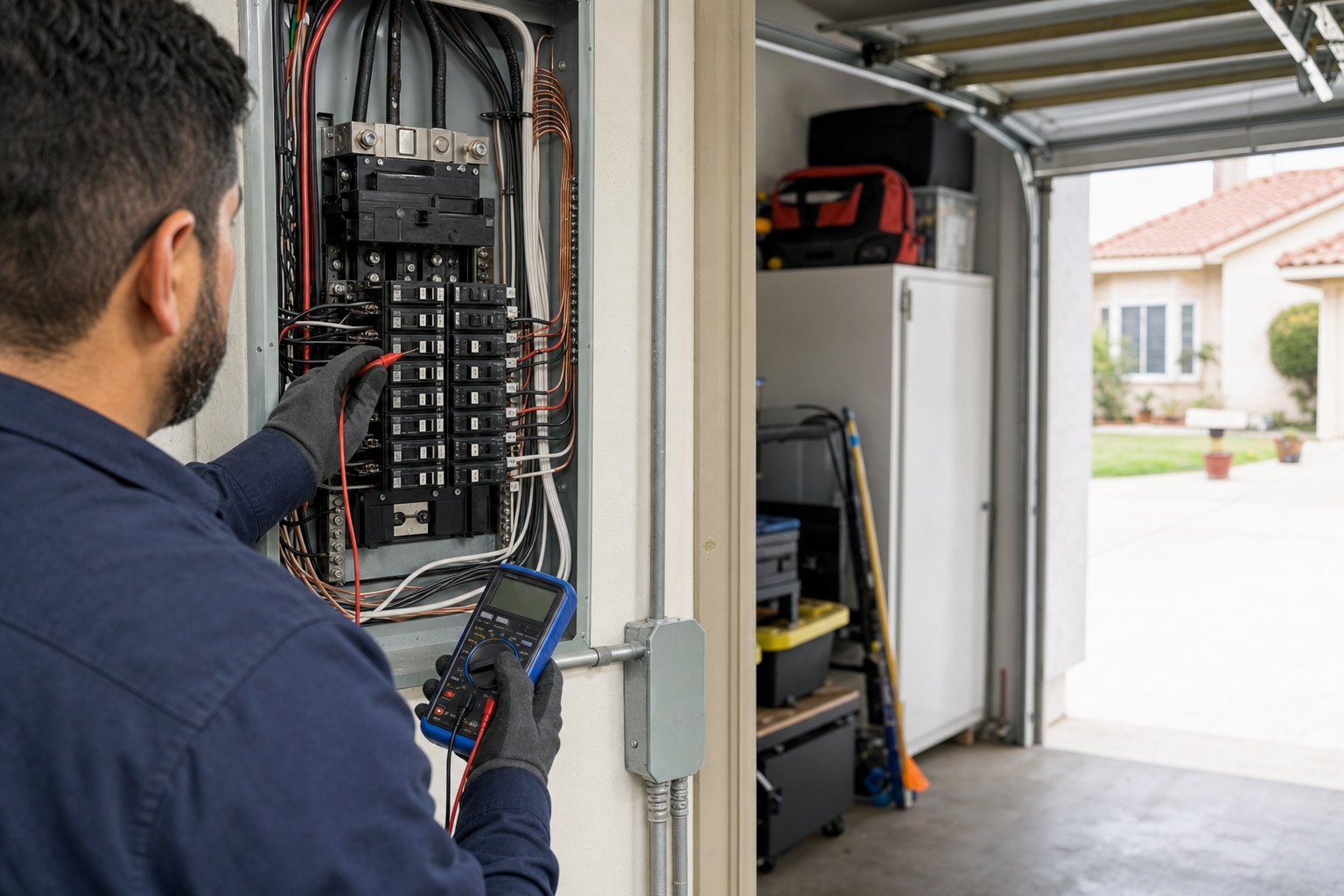
How Lakewood repair calls go sideways — and how to keep yours on track
Most repair frustration in older Lakewood homes comes from one of four places: access friction, hidden secondary failures, mis-diagnosed parts, or scope creep that nobody warned the owner about. Access friction is the easiest to prevent — clearing the garage, side yard, attic hatch, cleanout cap, or panel area before the visit lets the technician spend that hour on the diagnosis instead of the logistics. The other three need a tech who is willing to slow down for thirty minutes of verification before quoting a fix.
For electrical troubleshooting, the verification step usually involves a small set of measurements: amp draw under load, pressure at a specific test point, resistance across a component, water-level behavior at a fixture, or a camera view past the obvious entry point. Those measurements are what separate a $200 repair from a $200 repair plus a return visit two weeks later. Ask whether your visit included them, and ask the technician to walk you through what each reading meant before they leave.
Lakewood and Cerritos cluster context: The Lakewood and Cerritos cluster is the classic Gateway tract-home territory: postwar single-family homes, attached garages, slab foundations, mature landscaping, and progressively older infrastructure beneath. EV charger demand and heat-pump readiness is high here, which makes panel and duct conversations more frequent than they used to be.
Quick answer for Lakewood homeowners
Electrical Troubleshooting in Lakewood should start with a clear symptom, a clean access plan, and a realistic view of what can expand the scope. The visible problem may be fire hazard, hidden overheating, loose neutral, but the visit can change when the property adds side-yard condenser clearance, sewer cleanouts, or driveway staging. In a slab foundations, the technician may need to reach the equipment, panel, drain, shutoff, cleanout, garage, side yard, attic, crawl space, or utility location before the real diagnostic work starts.
The most useful preparation is simple: use the external booking link, add photos, list the exact symptom, note whether another fixture or appliance is affected, and confirm who controls shutoffs or utility areas. If the call involves no cooling, active leaking, gas odor, burning smell, repeated breaker trips, water heater failure, or a backup that affects more than one fixture, treat it as urgent. If the symptom is stable, use the same process to plan a repair, replacement, or inspection-ready estimate without forcing an emergency premium.
Best first move
Book through the external form, then prepare these items: Do not keep resetting breakers; Turn off affected circuit if safe; Keep people away from wet electrical areas; Photograph panel; List affected rooms. For Lakewood, add access notes for garage panel access; attic and crawl limitations; side-yard condenser clearance; sewer cleanouts; driveway staging.
Why electrical troubleshooting is different in Lakewood
Lakewood editorial note: Lakewood is a perfect older tract-home systems market: AC, panel, water heater, sewer, and slab-leak planning.
Lakewood sits in the Lakewood and Cerritos service cluster and is best understood as a classic postwar tract-home market with attached garages and mature trees. Homes around Lakewood Center area, Mayfair, Lakewood Village, Carson Street corridor can combine postwar single-family homes, attached-garage panels, slab foundations, older ducts, mature-tree lots on the same few blocks. That mix matters because the same electrical troubleshooting call can require different equipment, ladder access, shutoff windows, garage or side-yard clearance, tenant scheduling, old-panel review, or cleanup protection depending on the property. A postwar tract home may have a slab foundation and old ducts. A small rental may have limited panel labeling and high plumbing use. A compact lot may hide old pipes, old wiring, or nonstandard mechanical routing behind newer finishes.
The local utility context is also part of the plan: Southern California Edison electric service is typical, with SoCalGas context for gas furnaces, water heaters, dryers, ranges, and gas line safety. The permit and inspection context is local city building department or LA County Building and Safety depending on address, with mechanical, electrical, plumbing, and sewer scopes verified before work. For electrical troubleshooting, the permit question is: Troubleshooting can begin as diagnostic work; permanent repair, new wiring, panel replacement, or service changes may require permits and inspection. That does not mean every small diagnostic requires a major permit process. It means the repair should be separated from permanent replacement, new circuit work, gas or venting changes, sewer or pipe work, equipment relocation, or any scope that changes the building system.
Lakewood data-point snapshot
Reference points: Lakewood Center area; Mayfair; Lakewood Village; Carson Street corridor. Building mix: postwar single-family homes; attached-garage panels; slab foundations; older ducts; mature-tree lots. Access profile: garage panel access; attic and crawl limitations; side-yard condenser clearance; sewer cleanouts; driveway staging. Risk profile: duct leakage; old 100-amp panels; tree-root sewer pressure; water-heater age; slab leak signs. Seasonal operating context: hot inland afternoons; tree-root drain stress; dust buildup in returns. Nearby comparison markets for routing and internal links: Long Beach, Bellflower, Cerritos, Hawaiian Gardens, Norwalk.
Diagnostic electrical lens
Electrical troubleshooting pages should be diagnostic-first. The page should map partial power, dead outlets, loose neutrals, nuisance trips, panel noise, warm devices, and modified circuits before discussing permanent repair. In Lakewood, that lens is filtered through side-yard condenser clearance, sewer cleanouts, slab foundations, and tree-root sewer pressure. This is the reason the page does not treat electrical troubleshooting as a city-name swap: the service decision changes when the home, access, utility, and failure mode change.
A diagnostic lead should identify affected rooms, what still works, whether power is partial or total, what changed recently, whether devices feel warm, and whether any water is nearby. The weak shortcut is treating troubleshooting like an emergency page. This page is about finding the fault path before quoting rewiring, breaker replacement, or a panel upgrade.
- affected circuit map checked against duct leakage and garage panel access
- loose neutral symptoms checked against old 100-amp panels and attic and crawl limitations
- warm device or panel noise checked against tree-root sewer pressure and side-yard condenser clearance
- recent DIY or remodel work checked against water-heater age and sewer cleanouts
- wet-area separation checked against slab leak signs and driveway staging
A useful Lakewood dispatch note should sound different from a nearby-market note. For this page, the important local signals are Lakewood Center area, postwar single-family homes, garage panel access, duct leakage, and hot inland afternoons. Those details change how electrical troubleshooting is quoted, staged, diagnosed, and explained. They also help the visit avoid the common failure pattern where the technician arrives with the right trade skill but the wrong access assumptions.
From the truck — electrical troubleshooting field journal
Diagnostic work in older homes often comes down to one or two failed connections out of hundreds. The kit on the truck includes circuit tracers, non-contact voltage detectors, low-resistance ohmmeters, infrared thermometers for hot-spot detection, and outlet testers that distinguish open ground, reverse polarity, and open neutral. Calls usually resolve in 30 to 90 minutes once the right path is found.
Real call from the field
Norwalk home, half the kitchen lost power but no breaker tripped. Two prior electricians wanted to open walls. We mapped the circuit with a tracer to a backstabbed receptacle behind the fridge — neutral had burned itself loose at the device. Replaced the device, pigtailed properly, and tested the rest of the circuit. About 90 minutes total, no walls opened.
Most of my troubleshooting work in older homes ends at a single backstabbed termination or a single loose neutral. The fix is often $80 of parts. The diagnostic time is what is being charged for — and that is the right way to do this work.
Code, permit, and inspection context for electrical troubleshooting
Code references that govern this work
- NEC Article 110 — requirements for electrical installations
- NEC Article 250 — grounding and bonding
- NEC Article 300 — wiring methods
Permit window
Diagnostic work alone does not require a permit. Permit is triggered when permanent repair involves new wiring, device replacement at scale, or panel work.
Typical visit duration
30–120 minutes for typical residential diagnostic. Complex circuit-tracing in older homes can run 2–4 hours.
Inspection points we verify
- Circuit map verified room by room
- All devices on affected circuits tested with outlet tester
- Suspicious junction boxes opened and inspected for loose connections
- Infrared scan of panel and major load points
What is on the truck
circuit tracer, non-contact voltage tester, low-resistance ohmmeter, outlet tester (open ground / reverse polarity / open neutral), infrared thermometer, small mirror for inside boxes.
Five questions to ask before approving electrical troubleshooting work
The contractor's answers to these questions tell you whether the visit is going to be diagnostic-led or shortcut-led. There are no trick questions here — these are the questions a thoughtful tradesman is glad to be asked.
- What is your diagnostic process before opening any walls?
- Will you map the affected circuit and test every device on it?
- Are you scanning the panel with infrared as part of the visit?
- If the fault is intermittent, what is the plan for catching it?
Common mistakes to avoid in Lakewood
Most of these come from rushing diagnosis or quoting before measurement. They show up across Lakewood on calls our techs end up cleaning up after another contractor.
- Opening walls before tracing the circuit
- Replacing the device that failed without checking adjacent devices on the same circuit
- Ignoring the panel — many house-wide intermittent faults trace back to loose neutrals at the panel itself
- Skipping the thermal scan of the panel during a 'small' visit
Repair, replace, or inspection — decision criteria
Diagnostic-first is always correct. Permanent repair scope is decided after the fault is found, not before. If a contractor wants to open walls before tracing, they are skipping the diagnostic step.
Common failure modes and hidden risks
For this service, the common technical risks include fire hazard, hidden overheating, loose neutral, wet electrical equipment, unsafe DIY modifications. In Lakewood, local risks such as duct leakage, old 100-amp panels, tree-root sewer pressure, water-heater age, slab leak signs can make those symptoms more expensive or more urgent. A cooling failure may be caused by a small part, but condenser condition, airflow restrictions, dusty coils, or electrical disconnect problems can change the visit. A panel or EV charger issue may look like one circuit, but load calculations, utility coordination, or old grounding can decide whether the work is safe. A plumbing leak may look contained, but water can move under slabs, behind cabinets, through walls, and toward electrical areas faster than most owners expect.
Do not keep resetting breakers, running water into a backed-up drain, using a leaking water heater, or operating HVAC equipment that smells hot or is spilling water. Those actions can turn a repair into broader home damage. The safer path is to isolate what you can, document the symptom, protect nearby areas, and book a visit with complete access notes.