
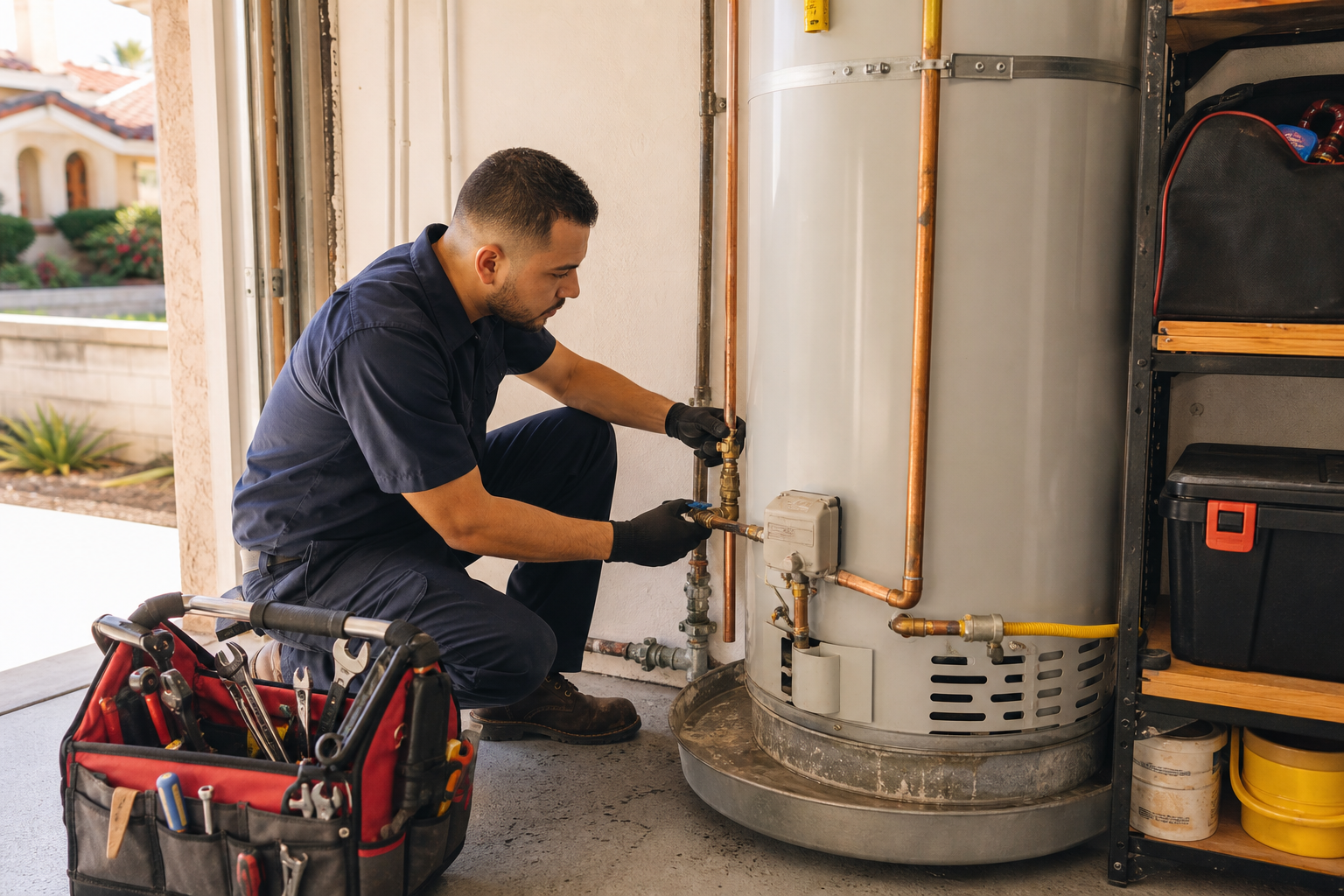
water heater service replacement, scoped honestly
Replacement in an older Paramount home is rarely a like-for-like swap. The new equipment is more efficient, more electronic, and often physically larger or smaller than what it replaces. That can change duct connections, gas or refrigerant line sizes, electrical disconnect specs, condensate routing, vent termination, mounting hardware, or footprint. None of those individually are dealbreakers — but together they decide whether the day of the install is calm or chaotic.
A clean replacement scope in Paramount should include: removal and proper disposal of the old equipment, modification of any line, vent, drain, or circuit that does not match the new equipment, code-required upgrades that come along with replacement (often things like seismic strapping, expansion tanks, drain pans, dedicated disconnects, or grounding), permit and inspection coordination, and a written warranty that names what is covered for how long. Ask for the scope in writing, item by item, before scheduling.
Compton and Lynwood cluster context: The Compton and Lynwood cluster combines tract homes, rentals, and industrial-edge properties along major freeway routes. Older 100-amp panels, slab leak risk, and sewer-lateral root intrusion are common scope expansions on what start out as smaller calls.
Quick answer for Paramount homeowners
Water Heater Repair and Replacement in Paramount should start with a clear symptom, a clean access plan, and a realistic view of what can expand the scope. The visible problem may be active tank leak, improper venting, failed shutoff, but the visit can change when the property adds water-heater clearance, cleanout location, or truck-route timing. In a garage panels, the technician may need to reach the equipment, panel, drain, shutoff, cleanout, garage, side yard, attic, crawl space, or utility location before the real diagnostic work starts.
The most useful preparation is simple: use the external booking link, add photos, list the exact symptom, note whether another fixture or appliance is affected, and confirm who controls shutoffs or utility areas. If the call involves no cooling, active leaking, gas odor, burning smell, repeated breaker trips, water heater failure, or a backup that affects more than one fixture, treat it as urgent. If the symptom is stable, use the same process to plan a repair, replacement, or inspection-ready estimate without forcing an emergency premium.
Best first move
Book through the external form, then prepare these items: Turn off water if leaking; Find gas or electrical shutoff; Photograph heater label; Clear garage or closet access; Note whether hot water is absent or leaking. For Paramount, add access notes for truck-route timing; driveway access; panel photos; water-heater clearance; cleanout location.
Why water heater service is different in Paramount
Paramount editorial note: Paramount should emphasize dust, maintenance, AC, and sewer-lateral content.
Paramount sits in the Compton and Lynwood service cluster and is best understood as a industrial-adjacent Gateway city with older homes and service access constraints. Homes around Paramount Boulevard, Rosecrans Avenue, 710 corridor can combine older single-family homes, duplexes, small apartments, garage panels, slab homes on the same few blocks. That mix matters because the same water heater service call can require different equipment, ladder access, shutoff windows, garage or side-yard clearance, tenant scheduling, old-panel review, or cleanup protection depending on the property. A postwar tract home may have a slab foundation and old ducts. A small rental may have limited panel labeling and high plumbing use. A compact lot may hide old pipes, old wiring, or nonstandard mechanical routing behind newer finishes.
The local utility context is also part of the plan: Southern California Edison electric service is typical, with SoCalGas context for gas furnaces, water heaters, dryers, ranges, and gas line safety. The permit and inspection context is local city building department or LA County Building and Safety depending on address, with mechanical, electrical, plumbing, and sewer scopes verified before work. For water heater repair and replacement, the permit question is: Water heater replacement may require permit and inspection, with attention to venting, seismic support, pan and drain, gas or electrical connections, and shutoffs. That does not mean every small diagnostic requires a major permit process. It means the repair should be separated from permanent replacement, new circuit work, gas or venting changes, sewer or pipe work, equipment relocation, or any scope that changes the building system.
Paramount data-point snapshot
Reference points: Paramount Boulevard; Rosecrans Avenue; 710 corridor. Building mix: older single-family homes; duplexes; small apartments; garage panels; slab homes. Access profile: truck-route timing; driveway access; panel photos; water-heater clearance; cleanout location. Risk profile: dust-loaded condensers; old panels; sewer backups; hard-water scale; slab leaks. Seasonal operating context: industrial air episodes; hot paved corridors; storm drain concerns. Nearby comparison markets for routing and internal links: Compton, Lynwood, Bellflower, Long Beach, Lakewood.
Water heater replacement lens
Water heater pages should focus on leak control, venting, seismic support, pan and drain routing, gas or electrical shutoff, hard-water scale, and inspection-ready replacement. In Paramount, that lens is filtered through water-heater clearance, cleanout location, garage panels, and hard-water scale. This is the reason the page does not treat water heater repair and replacement as a city-name swap: the service decision changes when the home, access, utility, and failure mode change.
A useful note includes tank age, leak location, whether hot water is absent, heater label photos, venting photos, shutoff condition, and whether water is moving toward belongings or electrical areas. The weak shortcut is replacing the tank without checking venting, pan drain, shutoff valves, expansion or pressure issues, and local inspection details.
- tank leak location checked against dust-loaded condensers and truck-route timing
- venting and combustion air checked against old panels and driveway access
- pan and drain route checked against sewer backups and panel photos
- gas or electrical shutoff checked against hard-water scale and water-heater clearance
- seismic support and valve condition checked against slab leaks and cleanout location
A useful Paramount dispatch note should sound different from a nearby-market note. For this page, the important local signals are Paramount Boulevard, older single-family homes, truck-route timing, dust-loaded condensers, and industrial air episodes. Those details change how water heater repair and replacement is quoted, staged, diagnosed, and explained. They also help the visit avoid the common failure pattern where the technician arrives with the right trade skill but the wrong access assumptions.
From the truck — water heater service field journal
Water heater swaps in Paramount carry permit, seismic, venting, pan, and shutoff requirements that the original install often skipped. The crew brings strap kits, expansion tanks, dielectric unions, sediment-trap fittings for gas, drain pans with proper exterior drain runs, and code-compliant shutoff valves. Inspection coordination starts before the old tank comes out.
Real call from the field
Long Beach, 50-gal in the garage leaking from the bottom. Long Beach has its own permit office; we pulled the permit before unloading the new tank. Replaced the unit with proper double-strap, installed an expansion tank (the PRV on the service line was making this required), repiped the dielectric unions, ran a new pan drain to the exterior. Inspected and signed off the next week.
Water heater installs go wrong on the things nobody sees: the strap height, the TPR discharge, the gas connector age, the pan drain route. A clean install is six little things done right, not one big thing.
Code, permit, and inspection context for water heater service
Code references that govern this work
- California Plumbing Code (CPC) Chapter 5 — water heaters
- CPC 507 — combustion air for gas water heaters
- CPC 504 — TPR valve and discharge piping
- California Earthquake-strapping requirement (Section 507.2)
Permit window
Permit required in every Gateway Cities jurisdiction for tank replacement. Inspection happens after install. Same-day replacement is possible if the contractor pulls the permit at the start of the work day.
Typical visit duration
3–5 hours for a like-for-like garage tank swap with no scope expansion. Longer if venting, gas line, or pan/drain need work.
Inspection points we verify
- Two seismic straps (upper and lower third of tank)
- TPR valve discharge piping to within 6 inches of floor or to exterior
- Drain pan with exterior drain run for indoor installs
- Sediment trap on gas line
- Combustion air sized to BTU input
- Vent termination clearances per CPC
What is on the truck
50-gal gas tank standard, expansion tank if PRV is on service line, 3/4 dielectric unions, yellow CSST flex or rigid black iron gas connection, drain pan with 1-inch drain, earthquake strap kit.
Five questions to ask before approving water heater service work
The contractor's answers to these questions tell you whether the visit is going to be diagnostic-led or shortcut-led. There are no trick questions here — these are the questions a thoughtful tradesman is glad to be asked.
- Is the permit being pulled, and from which jurisdiction?
- Is the existing TPR discharge code-compliant, or being corrected?
- Are seismic straps correct (two straps, upper and lower third)?
- Is an expansion tank needed (PRV present on service line)?
- Is the vent and combustion air evaluated, or assumed adequate?
Common mistakes to avoid in Paramount
Most of these come from rushing diagnosis or quoting before measurement. They show up across Paramount on calls our techs end up cleaning up after another contractor.
- Skipping the permit because it 'is just a swap' — fails on resale and home insurance claims
- One seismic strap instead of two — does not meet CPC 507.2
- TPR valve discharge missing or terminated more than 6 inches above floor
- Reusing old gas flex connector — most are 5–10 years and at the end of safe service
Repair, replace, or inspection — decision criteria
Replacement is correct at 10–12 years, or sooner if the tank is leaking, the anode rod is fully consumed, or the venting cannot be brought to code. Repair (anode rod, T&P, dip tube, element) makes sense when the tank is under 8 years and the failure is a single component.
How water heater service is sequenced step by step
This sequence is what a properly run water heater service project looks like — written for the homeowner who wants to know what should be happening and when.
- Permit and shutoffs. Pull the plumbing permit with the local jurisdiction. Verify the gas shutoff and water shutoff are functional before the project starts.
- Old tank drain and removal. Drain the old tank to the exterior or a proper drain. Disconnect gas, water, and venting. Remove the tank.
- Pan, drain, and seismic strap install. Install a code-compliant drain pan with an exterior drain run. Install two seismic straps (upper and lower third of tank) per California earthquake-strapping requirement.
- New tank set and connection. Set the new tank on the pan. Connect water with dielectric unions. Connect gas with code-compliant flex or rigid black iron, including a sediment trap. Re-vent per CPC clearances.
- TPR valve and expansion tank. Connect the TPR valve discharge piping to within 6 inches of floor or to exterior per CPC 504. Install an expansion tank if the service line has a PRV.
- Combustion air, leak test, inspection. Verify combustion air is sized to BTU input. Pressure-test the gas connections. Schedule the plumbing inspection.
Common failure modes and hidden risks
For this service, the common technical risks include active tank leak, improper venting, failed shutoff, water damage, gas appliance safety issue. In Paramount, local risks such as dust-loaded condensers, old panels, sewer backups, hard-water scale, slab leaks can make those symptoms more expensive or more urgent. A cooling failure may be caused by a small part, but condenser condition, airflow restrictions, dusty coils, or electrical disconnect problems can change the visit. A panel or EV charger issue may look like one circuit, but load calculations, utility coordination, or old grounding can decide whether the work is safe. A plumbing leak may look contained, but water can move under slabs, behind cabinets, through walls, and toward electrical areas faster than most owners expect.
Do not keep resetting breakers, running water into a backed-up drain, using a leaking water heater, or operating HVAC equipment that smells hot or is spilling water. Those actions can turn a repair into broader home damage. The safer path is to isolate what you can, document the symptom, protect nearby areas, and book a visit with complete access notes.